
Trash TV
an unruly defense
Dear Patron,
I love trash TV.
I do I do I do! With my whole chest, I will say that there is nothing better than a terrible, terrible, terrible show that has too much time and money and no good ideas. A close second is terrible movies. Just absolute garbage media. Stuff that takes millions of dollars and work hours and Expensive Equipment and Studio Approval and resolves into an incomprehensible rollercoaster that lacks plot-coherence and likable characters.
The reason TV wins is that a movie ends. No matter how convoluted and insane Valerian and the City of a Thousand Planets becomes, it is this immutable thing. The story began and somewhat resolves itself by the end. Trash TV is not bound to a run-time. It is a car crash that keeps going, the casualties piling up, building into an ever-increasing catastrophe. I cannot look away.
My particular brand of fixation are sprawling dramas, usually with a kind of fantasy twist, and teen leads with absent parents. The show generally needs two out of those three to count, but in special occasions it will meet all three.
Gossip Girl have the drama and the absent parents, as do Riverdale, Pretty Little Liars, and Veronica Mars. Charmed and Supernatural have the drama and the twist, but the siblings are adults. The Vampire Diaries manages all three, but to middling effect on all counts.
Watching these shows is thrilling to me the same way that prestige media is, if for opposite reasons. I think it all comes down to the promises that are made to the audience, and how the creators go about following through.
With a prestige show—for example, Twin Peaks— the promises tend to be defined to the audience early on.
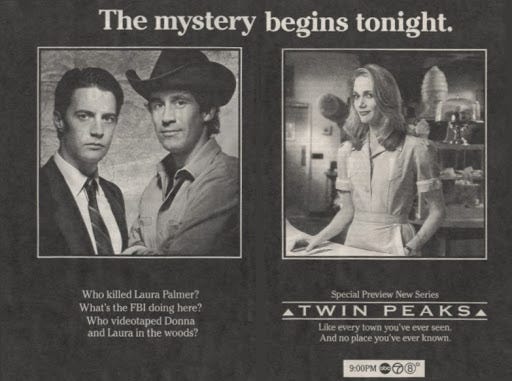
That promise, though, is just the set dressing. While the question of who killed Laura Palmer keeps you coming back, it’s the town of interconnected characters, their convoluted backstories, and the intrepid hero Agent Dale Cooper that make you satisfied with the wait. David Lynch’s original idea to never reveal the killer proves how essential that tension is to the show. Once you have that answer everything is allowed to slacken and unravel, and the writers scrambled to rebuild that tension without a central focus.
It’s the strength of the initial question and the faith in the promise firmly divides good media from the bad. Who is A? Who killed Jason Blossom? Who is Gossip Girl? Who killed Lily? This question is the problem that the narrative is designed to answer. The trap of it all is forgetting to fill out the world while trying to solve it, so if it’s ever revealed the whole thing doesn't collapse under your feet.
The reveal in Pretty Little Liars works because the scale increases but the stakes stay relatively the same. The ‘A’ title can seamlessly change hands, which allows the audience to be satisfied with an answer without the writers having to re-build a villain from the ground up. Veronica Mars holds off the reveal until the end of it’s second season, leaving the third season to land, somewhat gracefully, on the back of beloved characters.
Riverdale fails this, miserably. The show—based on the Archie comics, though that isn’t really important—initially branded itself as a edgy-teen-mystery-drama set in a quirky town. It’s obvious in it’s love of Twin Peaks, from the general aesthetic to the driving force of the first season — the murder of Jason Blossom. It’s enough to propel viewers, and writers, through the first season. The town and it’s set of wacky characters get some development, everything and everyone dark in a way that’s fun. These are the Archie characters, after all. It’s all glossy yet silly, interesting because of it’s insistence on taking itself seriously.
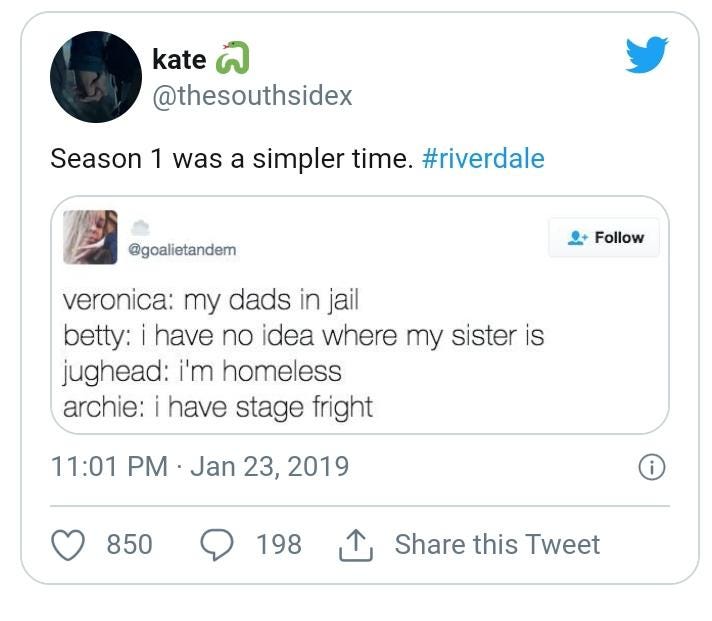
So when Jason Blossom’s killer is revealed in the season one finale the writers have to escalate, and it is in that escalation that Trash TV thrives. Stakes have to grow and grown and grown until everything becomes unfixed from reality to a glorious degree.
In season two there isn’t just a killer, but a serial killer. There’s not just an illegal maple syrup trade, but a sprawling criminal syndicate that’s getting the children hooked on ‘Jingle Jangle’ (cocaine) and ‘Fizzle Rocks’ (acid). There’s a cult that’s leader escapes a rocket, and a knock-off Dungeons and Dragons game controlled by a maniac. Jughead becomes the leader of a gang and Betty is his serpent queen. Veronica owns and operates a speakeasy. There’s a nunnery connected to human sacrifices and witchcraft. Archie goes to juvie and does this:
Nothing makes sense. It’s beautiful. Anything can happen and everything is meaningless.
When Trash TV is done right it becomes a game of speculation and comfort. There is enough reliability that I feel like I know the characters and where they’re heading, but enough chaos that I know they can swerve, mid-story line, into oncoming traffic. I know that they writers aren’t sure how to get the characters out of the wreck, but as I witness the crash—it’s pyrotechnic glory, the metallic crunch and operatic spray of debris—I can’t help but wonder what happens next. It’s bound to be ridiculous, and I can’t wait to see it.
The Rat Recommends
To Read
Vulture: “Confessions of a 32-Year-Old Drama Queen”
It is impossible to separate Paytas’s endless pursuit of attention from the things she has done to get it: She has been filmed rapping the N-word multiple times. She’s been accused of making mockeries of gender identities and mental disorders. Her videos have, on many occasions, flagrantly crossed the line between satire and cruelty.
While I love a fictionalized trail derailment, Trisha Paytas’s content has never appealed to me. I enjoyed this profile of her though, I think it explains the link between the rewards for controversial behavior and the kind of person who is willing to take advantage of that reward system to achieve notoriety.
New York Times: “My Year of Grief and Cancellation”
If you were on Tumblr in the early 2010s, you may remember a blog called Your Fave Is Problematic. If not, its content should still sound familiar to you. The posts contained long lists of celebrities’ regrettable (racist, sexist, homophobic, transphobic, ethnophobic, ableist and so on) statements and actions — the stuff that gets people canceled these days.
That blog was my blog.
I can’t think of a week that has gone by since first hearing the phrase “Your Fave is Problematic” that it hasn’t racketed around my skull. I never read the blog in it’s time, but that phrase met the culture where it was, and — in a lot of ways — where it still is. At the quote above says, it was a prelude to the cancel culture to come. We were in the beginning of the internet reckoning, and we had no idea what we were in for. What makes this piece worth reading is the reveal of the grief that motivated one high school senior to set about our doom.
The New Yorker: “E-mail Is Making Us Miserable”
E-mail is arguably one of the best examples of such unintentional consequences in recent history. It’s useful, of course, that we can communicate instantaneously, with almost no friction or cost. But humans are not network routers.
I’m obviously an email advocate, as I made sending them en masse one of my hobbies. Even though I am mildly obsessed with the medium, I am guilty of the vacation-day email stress. I’m not even an important, or in-demand, employee and I still felt the need to check to see if I was needed off the clock. I don’t like to think about what might happen if I became a person of authority.
To Watch
Folding Ideas: “A Lukewarm Defense of Fifty Shades of Grey”
I’m re-watching the “A Lukewarm Defense of Fifty Shades” trilogy of video essays again. It’s an incredibly nuanced critique of the trilogy of movies that is informative of not only how movies get made, the history of the Fifty Shades books, and the pains of adaptation — all the while being entertaining.
Brian David Gilbert: “Teaching Jake about the Camcorder, Jan ‘97”
For your daily dose of Existential Dread.
Jill Bearup: “The Lizzie Bennet Diaries: A Modern Morality Tale”
I loved The Lizzie Bennet Diaries back in the day, and YouTube throwing this recommendation at me was a welcome reminder off all of it’s good qualities.
Thank you for reading, as always. I hope my adoration of bad tv doesn’t make you think lessor of me.
FINEST REGARDS,
Andrea